Download your FREE actionable business checklist!
To start a golf fitness business, you need a simple space, a structured program, and a consistent marketing system. This video explains exactly how to set up your space, attract clients, and build a profitable golf fitness business. If you’re wondering how to attract clients once your foundation is in place, that’s the natural next challenge this guide prepares you for.
Download your FREE step-by-step checklist and discover exactly what it takes to start or grow your golf fitness business.
One of the most common questions we get from new and prospective FitGolf Affiliates is:
“What do I really need to get started?” The good news is this – far less than you think.
Many professionals delay getting started because they believe they need a large facility, expensive equipment, or a fully built-out business. In reality, the most successful golf fitness businesses are built on simplicity, clarity, and execution – not overhead. Being aware of the mistakes to avoid when building your golf fitness business can help you sidestep the most common traps that keep professionals stuck before they ever get started.
Let’s break it down. If you want a head start, there’s also a free resource program to get started that walks you through the essentials before you dive in.
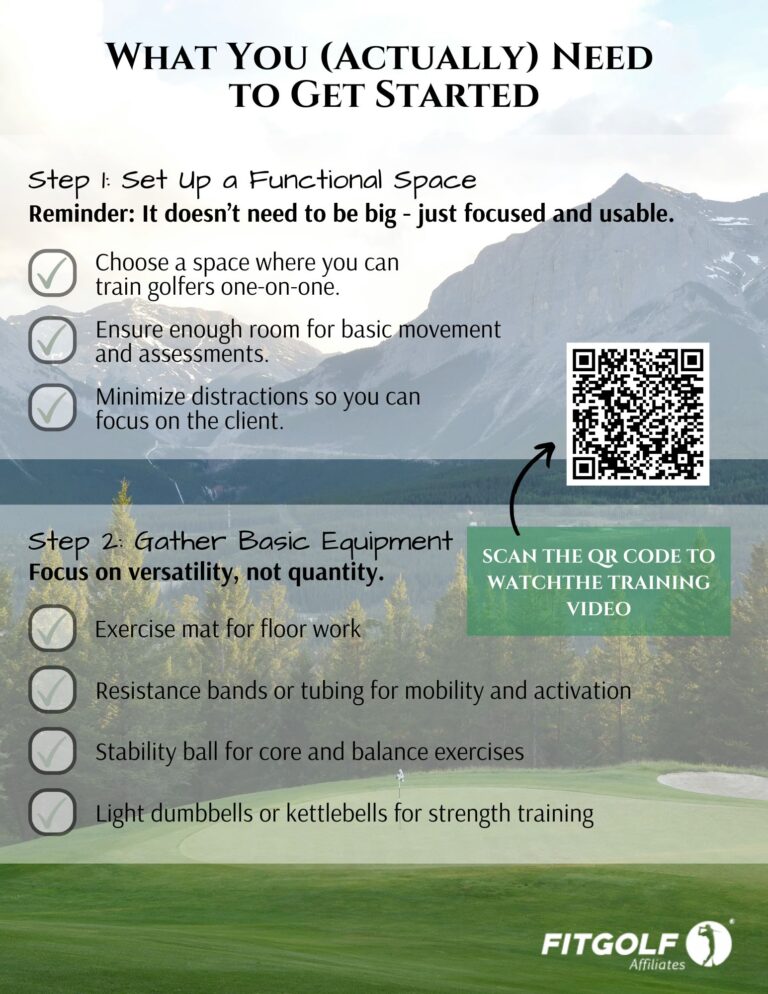
1. Your Space: Start Where You Are
Golf fitness businesses operate successfully in a wide variety of environments. We’ve seen affiliates build thriving businesses in:
- Personal training studios
- Small private rooms (as little as 400–500 sq ft)
- Physical therapy or chiropractic offices
- Country clubs and golf facilities
- Driving ranges or golf academies
- Shared spaces with golf instructors
- Clients’ homes or even their own home setups
- Outdoor spaces when appropriate
Key takeaway: You don’t need a large facility – you need a functional, focused space.
New Low-Overhead Models Continue to Emerge
One of the biggest shifts in recent years is the growth of mobile and hybrid golf fitness businesses.
Many professionals discover that starting simple is actually a competitive advantage because it allows them to focus on consistent action rather than unnecessary overhead. In fact, one of the biggest reasons golf fitness businesses never gain momentum isn’t lack of space or equipment – it’s simply failing to take consistent action in the first place.
Today, some professionals are successfully operating with:
- Mobile training services
- Pop-up programs at golf facilities
- Shared space arrangements
- Virtual coaching combined with in-person assessments
- Seasonal partnerships with country clubs and golf academies
These models can significantly reduce startup costs while allowing you to build a client base before investing in dedicated space.
The key isn’t the location itself – it’s having a consistent process for assessing golfers, delivering results, and creating a professional experience.
In fact, one of our most successful FitGolf locations operates out of a ~400 sq ft space at a driving range, using the outdoor area for swing integration.
2. Privacy Over Size
Golf fitness is a premium, personalized service. As a result, golfers expect:
- Individual attention
- Clear communication
- A degree of privacy
You don’t need a big space – but you do need a space where you can separate your client from distractions, especially during assessments and one-on-one sessions.
3. Equipment: Keep It Simple
For most professionals, a basic golf fitness setup can still be created for a relatively modest investment.
Depending on equipment quality and quantity, many startup setups can be assembled for approximately $500–$2,500, including:
- Exercise mats
- Resistance bands
- Stability balls
- Adjustable dumbbells or kettlebells
- Basic balance and mobility tools
While equipment costs have increased in recent years, the principle remains unchanged: golfers are paying for expertise and results – not access to expensive machines.
If you want a complete picture of how these elements come together from day one, see the full guide on how to start and grow a golf fitness business.
4. Define Your Golf Fitness Program and Services
Before you focus on growth, you need clarity in what you offer. At minimum, you should define:
- Your golf fitness assessment process
- Your core services (e.g., assessments, programs, memberships)
- A simple progression pathway from prospect → client
This creates confidence – for both you and the golfer. Understanding how a clear program and service offering shapes the outcomes you deliver – not just the number of clients you attract – is what separates sustainable businesses from those that stall.
5. A Simple Marketing & Onboarding System
This is where many businesses struggle – not because it’s complicated, but because it’s inconsistent. You need two things:
- Consistent activities that put golfers in front of you
(referrals, local outreach, social content, partnerships) - A clear process to convert interest into action
(how you invite them into an assessment and move them forward)
It doesn’t have to be complex – but it does have to be repeatable. And not all approaches are equal — understanding which referrals, local outreach, social content, and partnerships actually work will save you time and accelerate your results.
6. Understanding Profitability (Keep Overhead Low)
A simple way to evaluate your business is by looking at revenue per full-time equivalent (FTE) – in other words, how much revenue is generated per 40 hours of work.
Example:
- $290,000 annual revenue
- 2 full-time equivalents
- = $145,000 per FTE
While revenue targets vary by market, service model, and pricing structure, many successful service-based fitness businesses aim to continually increase revenue generated per professional hour while keeping overhead under control.
The goal isn’t necessarily to build the largest facility.
The goal is to create a business model where revenue grows faster than expenses.
It’s also worth understanding the number one reason businesses fail – because avoiding that trap is just as important as keeping your overhead low.
This is why starting small is often an advantage. With rising facility, equipment, and marketing costs, keeping your initial investment lean has become even more important than it was just a few years ago. Once your foundation is set, the real work begins – learning how to build and grow your client base is the natural next step in developing a sustainable golf fitness business.
What You Really Need to Start a Golf Fitness Business
You don’t need the “perfect setup” to start a golf fitness business. You need:
- A functional space
- Basic equipment
- A clear program
- A simple marketing and onboarding process
- And most importantly… consistent execution
Start where you are. Build as you grow. As your foundation solidifies, the next skill to develop is building recurring revenue in your golf fitness business so your income becomes predictable and scalable.
That’s how the most successful golf fitness businesses are created. Once you have the fundamentals in place, the next step is launching and growing your golf fitness business with a clear plan for attracting clients and scaling revenue.
Next Step: Learn how to eliminate unnecessary steps and keep your business moving forward by avoiding common pitfalls in Golf Fitness Business Stalls – Part 1: Take Action
Grow Your Golf Fitness Client Base and Revenue
looking to increase your client base and profit?
Let’s explore how adding golfers to your client base can multiply your bottom line. What is your professional role?